

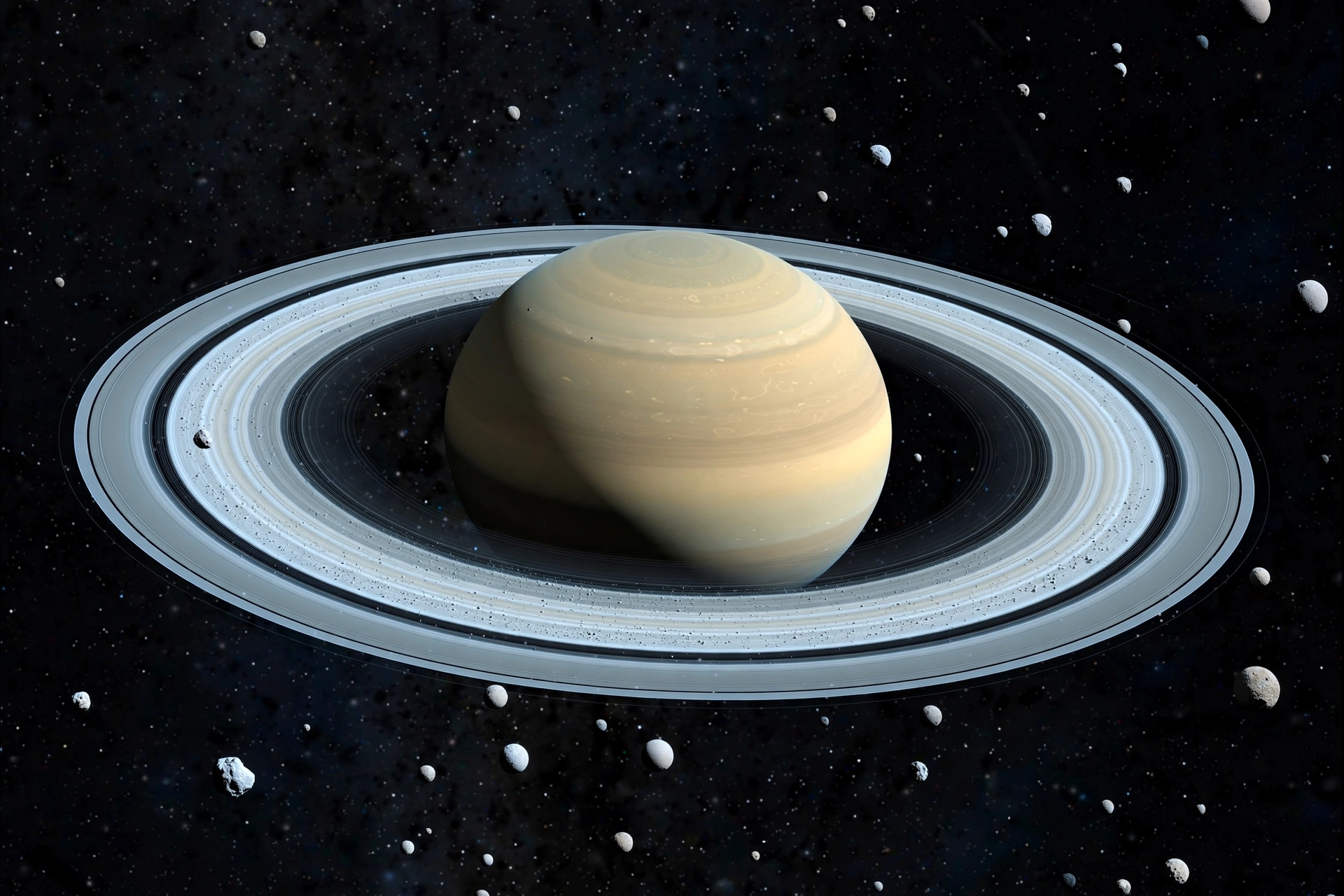
If you thought Saturn was showing off with its rings, wait until you hear about its moons. Astronomers have confirmed 128 new moons orbiting the planet, taking the official total to 274 — by far the biggest moon family in the solar system, and a number that makes Jupiter’s 95 look almost modest.
Before you picture 128 new worlds, a reality check: these are irregular moons, small and dark, most of them only a few kilometres across. They orbit far from Saturn, often at steep angles, and some travel in the opposite direction to the planet’s rotation. They are less like our Moon and more like rubble — but rubble with an extraordinary story.
The stacking trick that reveals invisible moons
So how do you find a two-kilometre rock a billion kilometres away? The team behind the survey, using the Canada-France-Hawaii Telescope, relied on a technique called shift-and-stack. They took long sequences of images of the patch of sky containing Saturn, then shifted each frame to follow the planet’s motion and stacked them together.
In the combined image, anything orbiting Saturn adds up into a visible point of light, while stars blur into streaks. It is the astronomical equivalent of a long-exposure photograph that makes a moving subject sharp. Researchers at the University of British Columbia then tracked each candidate over months and years until its orbit was certain enough for the International Astronomical Union to make it official.
The method is a lovely counterpoint to the SpaceX launch that drew a jellyfish in the sky: one story written in rocket exhaust across a single dawn, the other assembled patiently from years of faint pixels.
Why astronomers care about space rubble
Irregular moons are believed to be captured asteroids and the fragments of larger bodies that collided and broke apart. They travel in families — groups with similar orbits that point back to a single parent object. Each new moon added to a family sharpens the reconstruction of that ancient smash-up.
With 128 additions, some families have effectively doubled in size overnight. That gives scientists a much better dataset for working out when the collisions happened and how chaotic the young solar system really was.
Is the race with Jupiter over?
For the moment, Saturn’s lead looks safe, but astronomers are honest that the league table says as much about our telescopes as about the planets. Thousands of small moons around both giants are probably still undetected, waiting for more sensitive surveys.
New observatories coming online this decade will see fainter still. When they do, expect this headline again — with an even bigger number in it.
Meet the families: Inuit, Gallic and Norse
Saturn’s irregular moons are organised into families with wonderfully human names. The Inuit group orbits prograde — the same way Saturn spins — at moderate tilts. The Gallic group does the same on somewhat different orbits. The Norse group, by far the largest, goes the other way entirely: dozens of moons circling backwards, spread over a huge range of distances, almost certainly the wreckage of one or more very large captured bodies.
Most of the 128 newcomers are expected to swell the Norse ranks, and each addition helps astronomers argue about the group’s history with better evidence. Was there one enormous parent moon that shattered, or several smaller ones? Did the break-up happen billions of years ago, or — as some researchers provocatively suggest — surprisingly recently? The answers are written in the spread of the orbits, and the penmanship just got considerably clearer.
There is a pleasing thought to end on. Every one of these moons has been orbiting Saturn since long before humans existed, patiently reflecting sunlight too faint for any eye to see. They were not created by the announcement, merely noticed by it. Somewhere in the gap between those two ideas — between what exists and what we have bothered to look for — most of astronomy still lives.
