

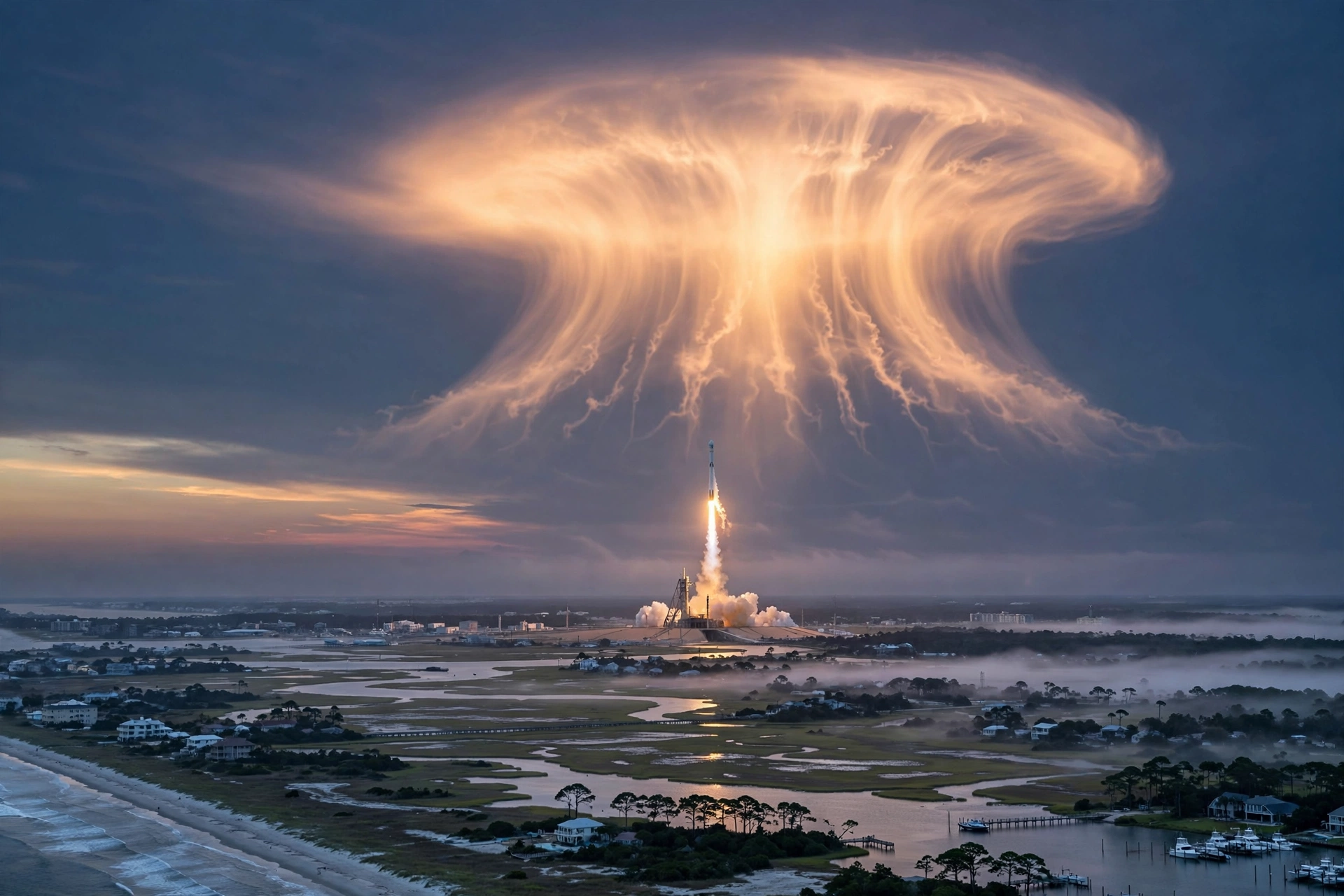
Early risers along the United States East Coast were treated to an unusual sight this week when a SpaceX rocket launch produced a glowing, expanding cloud that looked strikingly like a jellyfish drifting through the dawn sky. Photographs shared from coastal communities showed a bright core with soft, translucent tendrils spreading beneath it, visible far from the launch site. According to reporting by The Guardian, the spectacle appeared as the rocket climbed into sunlight while the ground below was still in relative darkness.
What Creates a Jellyfish Cloud?
The effect, often called a space jellyfish or twilight phenomenon, is not a cloud in the ordinary weather sense. It forms when exhaust gases from a rocket expand in the thin upper atmosphere, where air pressure is far lower than at sea level. Instead of staying in a tight stream, the plume spreads outward into a broad, rounded shape. When the timing is right, shortly before sunrise or just after sunset, sunlight catches those high-altitude gases and ice crystals while observers on the ground are still standing in shadow. The contrast is what makes the plume glow so vividly against a dark blue sky.
Geometry matters as much as timing. A launch in the middle of the day produces the same expanding exhaust, but the plume is washed out by daylight and is far harder to notice. A launch in the middle of the night can be spectacular close to the pad, yet the plume may not be lit at all. The launches people remember, the ones that stop traffic and fill social media feeds within minutes, are the ones that thread the narrow window in between.
Why This Launch Was Seen So Far Away
Because the display happens at very high altitude, it can be visible across a remarkably wide area. Residents hundreds of miles from the launch site can sometimes see the same illuminated plume, provided the sky is clear and they have an unobstructed view towards the coast. That explains why images of a single Florida launch often arrive from several states at once, each showing the jellyfish from a slightly different angle. For anyone who tracks launches on a phone, our guide to improving navigation on a mobile screen is a useful reminder that a clear, simple interface helps when you are following fast-moving updates outdoors.
Weather played its part too. Thin high cloud can soften the effect, while humid, hazy air near the ground can hide the lower tendrils of the plume. On a crisp, clear morning, by contrast, every stage of the display stands out: the bright ascent, the moment the plume blooms outward, and the slow fade as the exhaust disperses and the sky brightens.
A Reminder of How Busy Orbit Has Become
Displays like this one are becoming a familiar by-product of a busier launch industry. Commercial rockets now lift off far more frequently than they did a decade ago, carrying satellites, cargo and crews, and each dawn or dusk launch is a chance for the public to see that activity with the naked eye. SpaceX publishes its upcoming missions on its official launches page, and checking that schedule against local sunrise and sunset times is the simplest way to predict whether the next jellyfish might appear over your neighbourhood.
The phenomenon also has a serious side for scientists. Plumes and their behaviour in the upper atmosphere interest researchers who study how gases disperse at extreme altitudes, and striking public sightings often prompt fresh interest in the physics involved. Photographs taken by ordinary onlookers, each with a precise time and location, can even help enthusiasts reconstruct exactly what was seen and when.
How to Catch the Next One
If you want to see a space jellyfish yourself, start with the launch schedule and look for departures in the hour before sunrise or the hour after sunset. Choose a spot with a clear view towards the launch direction, arrive a few minutes early, and let your eyes adjust to the low light. A phone camera on night mode can capture colours the eye barely registers, but give yourself a moment to simply watch as well. As sites that cover launches well know, and as our piece on building a more resilient niche blog notes in a different context, the audiences who return are the ones who were given a clear, honest explanation of what they were looking at.
No special equipment is needed, and no two displays are exactly alike. Wind at altitude, the rocket’s trajectory and the precise angle of the sun all change the shape in the sky. That unpredictability is part of the appeal: for a few minutes, a routine commercial launch becomes a piece of natural-looking art overhead, and a reminder that some of the most memorable sky events now begin on a launch pad rather than in the weather.
