

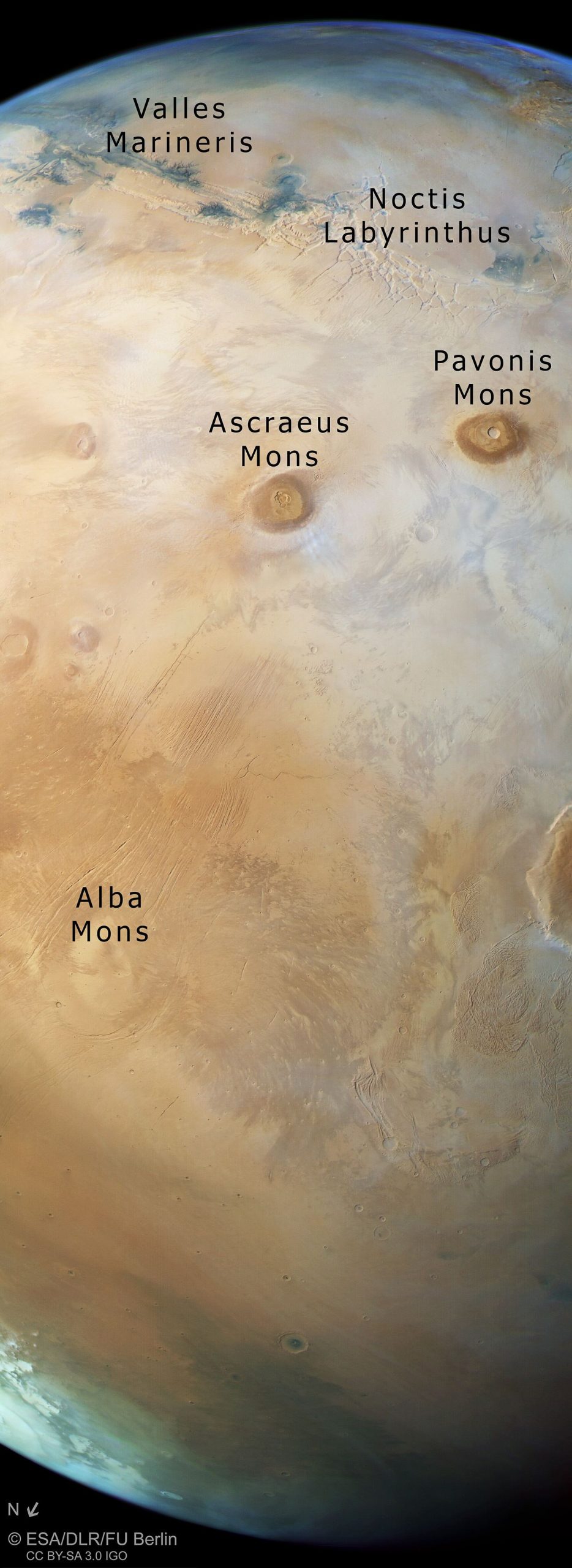
Gas seeping from cracks on Mars suggests the planet is not geologically dead deep inside, but merely sleeping, with magma possibly still moving beneath the surface. The evidence was published in Science Advances on 4 November 2026 by an international team led by Alexander Trokhimovskiy of the Space Research Institute at the Russian Academy of Sciences. The ExoMars Trace Gas Orbiter, a joint mission of the European Space Agency and Roscosmos, recorded unexpected spikes of hydrogen chloride above the northern hemisphere in early summer. The spikes repeated across multiple Mars years, each nearly two Earth years long, and always appeared above fresh fissures on the flanks of Alba Mons, a giant shield volcano spanning roughly the area of the contiguous United States. Hydrogen chloride is a gas that hot magma produces on Earth.
What the Evidence Shows
The pattern is what makes the finding convincing. The gas appeared just after the frosts of winter sublimated, as if ice sealing the fissures had melted and let the trapped gas escape, and the ground around the cracks shows discolouration like the deposits left around volcanic gas vents on Earth. The team’s cameras found young, narrow fissures spanning tens to hundreds of metres, and the gas was detected at parts-per-billion levels, a handful of molecules spotted by an orbiter moving continuously around the planet. The researchers suggest a dormant magma chamber hides below Alba Mons, a kind of volcanic plumbing system under the surface. If Mars still holds enough internal heat for magma, the warm fissures could host environments like Earth’s hydrothermal vents, where life on our planet may have emerged, and they become places to search for life on Mars. Reporting and analysis from sources such as National Science Foundation track the same developments, and specialists following volcanic gas on Mars say the direction is now consistent across independent lines of evidence.
The Wider Context
The wider context is a research landscape in which replication and open data now decide reputations. Findings connected to volcanic gas on Mars are being checked by independent groups with shared datasets, and the teams involved publish their methods in full so rivals can test every step. That discipline is slower than a headline cycle, but it is why results in this area increasingly survive first contact with scrutiny.
What Happens Next
What happens next in the story of volcanic gas on Mars will be decided by follow-up work already under way: larger samples, longer observation and instruments that have not yet come online. The researchers involved are unusually united on one point, that the current results justify the next investment of time and money. Readers will not have to wait long for the first tests of that claim. You can follow related developments in our coverage of science.
There is a practical lesson in all of this for readers deciding what to do today. Start with the verified facts, be wary of anyone promising certainty, and prefer reversible steps while the evidence is still developing. Circumstances differ by country, income and personal situation, so general guidance should always be weighed against your own context before you act on it in any significant or lasting way.
