

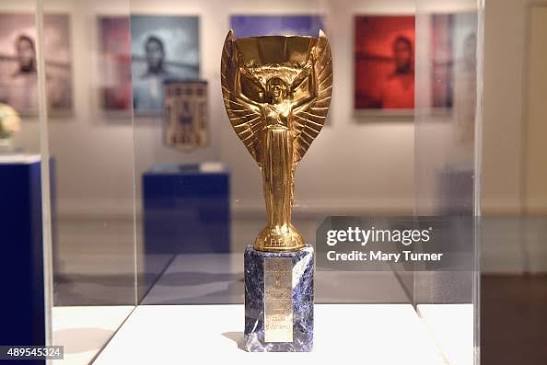
The World Cup has had only two main trophies in nearly a century, but the way those designs evolved tells you a lot about how fans read finals, dynasties, and “history on the line” when they watch live. From the classical Jules Rimet Cup to the modern FIFA World Cup Trophy, each era’s design has shaped how viewers imagine legacy, pressure, and what it actually means to see a captain lift that object after 90 or 120 minutes.
What the Jules Rimet era meant for how fans viewed domination
The original Jules Rimet Trophy, first awarded in 1930 and later renamed to honour FIFA president Jules Rimet, looked like a traditional, almost museum-like piece: Nike, the Greek goddess of victory, holding a chalice atop a lapis lazuli base. Because the rules allowed any nation with three titles to keep it permanently, every final in that era carried an extra narrative weight when a dominant team neared that threshold, especially Brazil in the 1958–1970 cycle. For viewers, knowing that a win could move a country closer to owning the trophy outright added a structural storyline on top of the match itself, making repeated finalists feel like they were playing not just for a title but for custody of football’s main symbol.
How the design and rules of the Jules Rimet Cup affected match narratives
The Jules Rimet era encouraged fans to think in terms of dynasties, because the trophy was designed to be “won” as an object, not just borrowed as a symbol. Once Brazil secured a third title in 1970 and took the cup permanently, every earlier final with them retroactively felt like part of a larger arc, especially when you rewatch with that knowledge in mind. When you watch those classic finals today, you can layer that context over the match: late-game decisions, risk-taking, and celebrations all sit inside a story where players know they are chasing something that could literally leave the global stage.
Transitional lessons from the thefts and loss of the original trophy
The repeated thefts of the Jules Rimet Trophy, including the famous 1966 incident in London and the 1983 theft in Brazil after it had been awarded permanently, forced FIFA to rethink how the symbol of the competition should be handled. The fact that the original cup was stolen and never recovered gave the object an almost mythic aura, but it also highlighted the risk of linking the tournament too tightly to a single physical artefact. For viewers, that history subtly shifts how later finals feel: you are no longer watching a match where the trophy might change permanent hands, but a match where a protected global icon briefly visits the winners before returning to FIFA’s care.
Mechanisms behind the shift from “possession” to “symbol”
FIFA’s rule changes after Brazil kept and then lost the Jules Rimet Trophy reveal a clear mechanism: trophies would become centrally controlled symbols, not prizes that leave the institution forever. The modern protocol—presenting the real trophy only briefly before replacing it with a replica—turns the lifting moment into a carefully choreographed ritual rather than a permanent transfer. That change encourages viewers to interpret the object less as property and more as a recurring emblem that connects eras, making each final look like a new chapter in one ongoing story instead of a race to “win and keep.”
How the modern FIFA World Cup Trophy reframed what we see on screen
Introduced in 1974 after a global design competition, the current FIFA World Cup Trophy shows two human figures lifting the globe, stands about 36 cm tall, and is made of 18-carat gold with a malachite base. Its design explicitly aims to represent the global, unifying nature of football rather than a classical statue, which affects how television cameras use it as a visual anchor before and after matches. When you watch modern finals, repeated close-ups of the trophy on a plinth, shots of players staring at it in the tunnel, and slow zooms as captains walk toward it all work because the object now reads as a universal symbol rather than a prize on the verge of leaving the stage.
What to focus on during live coverage when the trophy is in frame
Modern broadcasts build an arc around the trophy from the moment teams walk onto the pitch, and reading those sequences consciously can change how you experience the final. Instead of treating trophy shots as pure emotion, you can use them to anchor your understanding of how pressure and history sit on players’ shoulders at different points in the game. Noticing when and how directors cut to the trophy—before kick-off, after goals, during VAR breaks, or just before penalties—helps you see how the match narrative is being framed in real time.
- Watch how players react when they pass the trophy on the way out of the tunnel: eye contact, glances, or deliberate avoidance.
- Notice whether broadcasters show the trophy more often when the match is tense or drifting, signalling an attempt to re-center the sense of occasion.
- Track how the camera lingers on the engraving base, subtly reminding viewers of previous champions.
- Observe whether the lifting ceremony emphasises the team as a collective around the podium or isolates the captain as central figure.
- Pay attention to how quickly the trophy is removed from pitch-level after celebrations and replaced by replicas or medals.
Reading these cues can help you understand how the production team wants you to feel about the match—historic, transitional, or routine—independent of the quality of play. Over multiple tournaments, you can also see how often certain nations appear alongside the trophy in pre-match montages, which builds or erodes the sense of a “natural” hierarchy long before the เว็บดูบอลสด goaldaddy is kicked. That awareness makes it easier to separate broadcast storytelling from what the tactical patterns on the pitch actually justify.
Why knowing trophy history matters when you ดูบอลสด finals
When you ดูบอลสด of a World Cup final, the trophy becomes a constant visual and emotional reference point even when you focus mainly on tactics and game flow. Understanding that Brazil once kept and then lost the Jules Rimet Cup, or that the current trophy can never be owned outright, reshapes the stakes you project onto specific finals: some matches feel like legacy-defining steps in a long relay, others like potential turning points in who gets repeatedly engraved on the base. That context encourages you to read small tactical choices—a team protecting a 1–0 lead instead of chasing a second goal, a coach trusting experience over youth—as decisions made with the weight of that engraved history in mind, not just with 90 minutes in view.
A simple timeline table: from Jules Rimet to the modern cup
The evolution of the trophy can be sketched in a compact timeline that highlights how design, ownership rules, and symbolic weight have shifted. This overview gives you a mental framework whenever broadcasters reference “adding a star” or “lifting the famous trophy again” during live commentary.
| Era / trophy | Years in use | Key design features | Ownership rule and symbolic impact | Viewing takeaway during finals |
| Jules Rimet Trophy | 1930–1970 | Nike holding chalice, gold-plated silver, lapis base | Nation keeping it permanently after 3 titles, Brazil achieved this in 1970 | Finals framed as steps toward “winning the cup forever” |
| Interim / replacement | 1970–1974 | Commissioning of new design after Brazil’s third win | FIFA moves away from permanent national ownership | Transition from object-as-prize to centrally held symbol |
| FIFA World Cup Trophy | 1974–present | Two human figures lifting globe, 18-carat gold, malachite base | Winners only receive the real trophy temporarily; replica kept at home | Finals framed as adding a name to a shared global icon |
Viewed through this lens, every modern final feels less about who “takes the cup home forever” and more about which nation joins or re-joins the engraved list on a single, tightly controlled symbol. That shift encourages you to see the match as part of a long continuum rather than a one-off event detached from earlier eras.
How trophy design interacts with match flow, celebrations, and memory
The physical shape of the trophy influences how captains raise it and how photographers and directors capture that moment, which in turn affects how you remember entire tournaments. The modern design, with its upward spiral and globe, is easier to hold aloft in one motion than the more static, chalice-like Jules Rimet Cup, which produces dynamic images that editors can cut over replays and retrospective montages. As a viewer, recognising this interplay between object and choreography helps you separate how dramatic a final truly was from how powerful the final montage feels a few minutes later.
Summary
The evolution from the classical Jules Rimet Cup to the modern FIFA World Cup Trophy reshaped not only what the winners lift, but how fans and broadcasters frame finals, dynasties, and legacy when they watch live. Permanent ownership and later theft turned the original trophy into a story about dynasties and scarcity, while the current centrally kept, globally branded trophy encourages viewers to see each final as another name etched onto a shared symbol of the sport. When you understand that history and pay attention to how coverage uses the trophy in shots, montages, and commentary, you can watch future World Cup matches with a clearer sense of which emotions come from the actual football and which are being projected through the gleam of gold on the podium.