

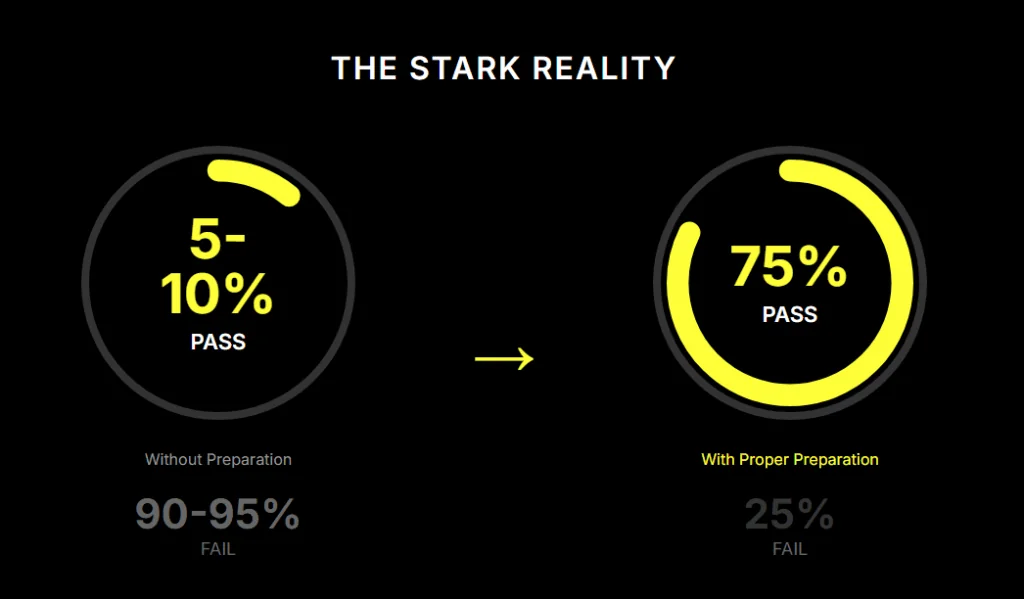
Most traders focus on passing a prop firm challenge as quickly as possible. They study strategies, indicators, and setups, yet still fail repeatedly. The missing piece in most cases is not strategy. It is consistency.
Prop firms are not designed to reward occasional big wins. They are designed to identify traders who can perform steadily under rules. Building consistency before attempting a challenge dramatically increases your chances of success.
Why Consistency Matters More Than Profit
A trader can be profitable and still fail a challenge.
This happens when:
- Profits come from a few oversized trades
- Losses fluctuate wildly
- Risk rules are barely respected
Prop firms prioritize controlled behavior. Even moderate profits achieved consistently are more valuable than aggressive swings. This is why firms like Funded Trader Markets emphasize structured evaluation models instead of one-off performance.
Start With Fixed Risk Per Trade
Consistency begins with risk control.
Before attempting any challenge:
- Fix your risk per trade (usually 0.5%–1%)
- Never increase risk to “speed things up”
- Accept small losses as normal business costs
If your risk changes trade to trade, your results will never stabilize.
Trade Fewer Setups, Not More
Many traders believe more trades mean more opportunities. In reality, more trades usually mean more mistakes.
To build consistency:
- Define 1–2 high-probability setups
- Trade only when those conditions appear
- Skip sessions with unclear market structure
Consistency comes from repetition of the same process, not constant action.
Create a Routine That Matches Challenge Conditions
Your preparation should mirror the challenging environment.
That means:
- Trading during the same hours you plan to trade in the challenge
- Respecting daily loss limits even on demo
- Stopping after hitting your self-imposed drawdown
If you cannot follow rules in practice, you will not follow them in evaluation.
Track Behavior, Not Just Results
Most traders only track profit and loss. That’s not enough.
You should also track:
- Whether trades followed your plan
- Emotional state before and after entries
- Reasons for exiting early or late
This is how patterns emerge. Consistency improves when behavior becomes predictable.
Test Your Stability Over Time
Before starting a challenge, ask yourself:
- Can I trade two full weeks without breaking rules?
- Are my drawdowns controlled and repeatable?
- Do my results come from process, not luck?
If not, more screen time is needed.
Structured models like one-step prop firm challenges reward traders who already have stability, not those still experimenting.
Avoid the “Challenge Mentality” Too Early
One of the biggest mistakes is treating the challenge as the place to improve.
The challenge is not training. It is an exam.
Training happens before:
- On demo accounts
- On small live accounts
- Through journaling and review
Once consistency is built, the challenge becomes execution, not experimentation.
Conclusion: Consistency Is a Skill You Build
Consistency is not something you suddenly discover during a challenge. It is built slowly through discipline, repetition, and restraint.
Traders who focus on stability before funding attempts trade with less stress, fewer mistakes, and better results. When your process is consistent, passing a prop firm challenge becomes a natural outcome, not a gamble.