

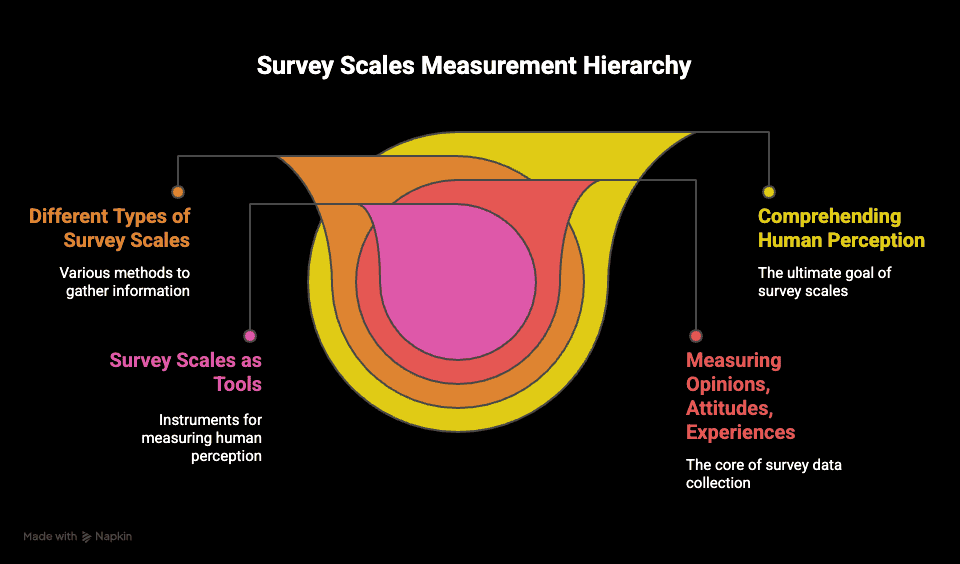
Surveys don’t just collect answers. They translate opinions into data. That translation is closely tied to survey scales. While great questions will elicit interesting responses, bad scale choices result in weak insights.
Good scales are easy to answer and enable respondents to answer honestly and consistently.
What Survey Scales Really Do
In its essence, survey scales organize ambient views. They translate emotions, sentiments, and perceptions into quantifiable responses. Without them it is ambiguous and difficult to judge answers against each other.
Scales help researchers:
- Measure intensity, not just direction
- Compare responses across groups
- Track changes over time
The right scale brings clarity. The wrong one creates noise.
Common Types of Survey Scales
Different questions need different scales. No single format works everywhere.
There are several survey scales that tend to be used more frequently:
- Agreement scales (from strongly agree to agree to disagree to strongly disagree)
- Use of rating scales like 1 to 5, or 1 to 10
- Frequency scales (never to always)
- Satisfaction scales (e.g., from very satisfied to very dissatisfied)
Each serves a specific purpose. It is important that the scale be matched to the question.
Simpler Is Usually Better
Options aren’t always the best data. Respondents may feel overwhelmed by too many points and deliver less accurate results.
Effective survey scales are:
- Simple to comprehend at first sight
- Balanced on both ends
- Clearly labelled
Answers improve when respondents are not asked to think very hard about the scale.
Consistency Improves Data Quality
When we change the format of the scale within a survey, it adds to the confusion. Respondents misinterpret options or choose answers in a hurry.
Using consistent survey scales:
- Reduces response errors
- Speeds completion
- Improves comparability
This consistency inspires confidence in the results.
Labels Matter More Than Numbers
Numbers can say whatever you want − it can mean different things to different people. Labels provide context.
Without an explanation, a “4” means nothing. When the labels are clear, respondents tend to select well and this reduces noise in the guesses. A good scale in surveys will always lead the interpretation
Avoid Forcing Precision
Not all opinions are precise. Some say they are neutral or don’t know. And scales that don’t let you do this force people to take shots in the dark.
Adding a neutral or second avoids this problem and tends to make surveys more honest and less irritating.
Test Before You Launch
Scales may behave differently in practice despite being well designed. At this point, a light test shows what is confusion or bias before it goes into full roll-out.
Testing out the survey scales in a pilot gets us to catch:
- Ambiguous labels
- Unbalanced options
- Misinterpretation
Minor repairs performed earlier eliminate major issues that will develop in future.
Final Thoughts
The devil is in the details in any kind of survey, either a success, or a failure. For instance, survey scales are one of the most important elements of them all. It is this that makes data meaningful and usable, when scales are clear, consistent, and appropriate to the question.
Strong scales don’t complicate surveys. They streamline answers − and strengthen insights.
