

Pounds are commonly used in countries such as the United States for measuring body weight, food items, and packages. Kilograms are widely used in most countries around the world because they are part of the metric system. Whether you are tracking fitness goals, checking luggage weight, or studying mathematics, understanding lbs to kg conversion is a practical and valuable skill.
The world is divided by many things: language, culture, and geography but one of the most persistent divides is the way we measure weight. If you’ve ever looked at a gym plate, a luggage scale, or a scientific formula and felt a momentary lapse of mathematical confidence, you aren’t alone. Understanding how to convert pounds (lbs) to kilograms (kg) is more than just a classroom exercise; it is a vital skill for international travel, global commerce, and health management.
The Science of the Scale: Defining the Units
To convert weight accurately, we must first understand what these units actually represent. The pound (lb) is a unit of mass used primarily in the United States and the British imperial system. Its origin dates back to the Roman libra, which is why we use the abbreviation “lbs.”
On the other side of the scale is the kilogram (kg), the base unit of mass in the International System of Units (SI). Used by almost every country on Earth and the entire scientific community, the kilogram provides a universal standard. Unlike the pound, which has had various historical definitions, the kilogram is now defined by the Planck constant, ensuring it remains a fixed physical constant across the universe.
Why Accuracy Matters in Weight Conversion
In our daily lives, a small rounding error might not seem like much. However, in specific professional fields, the difference between a pound and a kilogram can have massive implications.
Understanding how to convert lbs to kg is an important skill in everyday life, fitness, health, education, and international travel. Different countries use different systems for measuring weight, which often creates confusion when reading product labels, gym records, or medical information. Pounds belong to the imperial system, while kilograms are part of the metric system. Learning how to convert between these two units helps improve accuracy and understanding.
Aviation and Travel
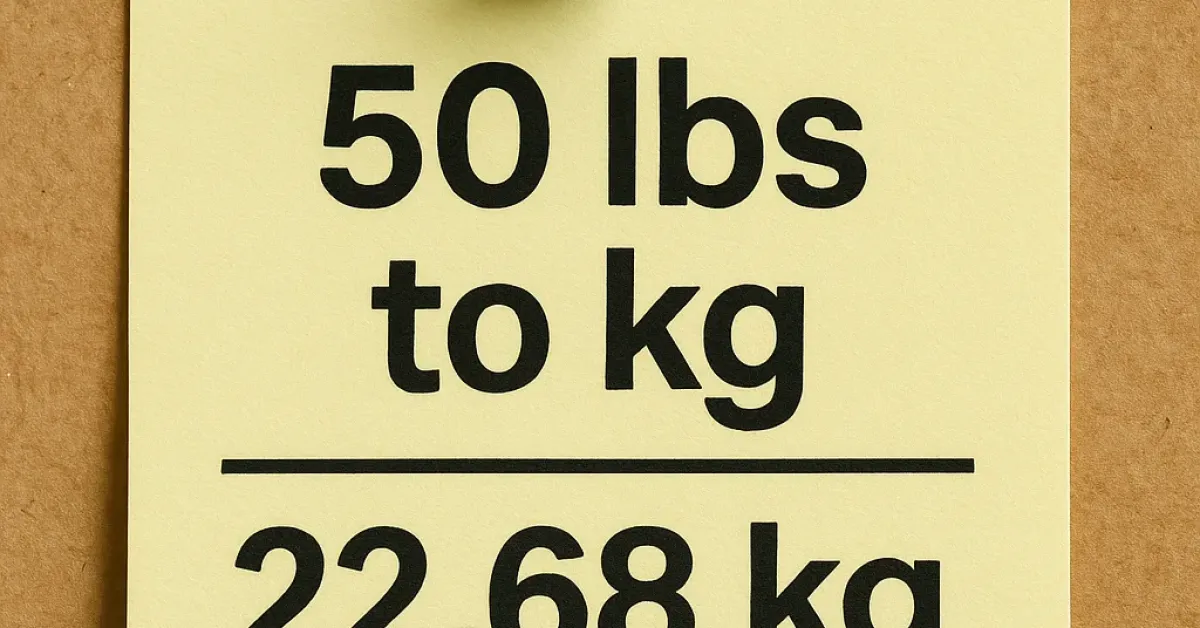
Airlines are notoriously strict about luggage weight. Most international carriers set a limit of 23 kg for checked bags. If you are used to thinking in pounds, you might assume 50 lbs is a safe bet. In reality, 50 lbs is approximately 22.68 kg. While you’re safe in that instance, a slight miscalculation could result in hefty “oversize” fees at the check-in counter.
Medical and Pharmaceutical Precision
This is perhaps the most critical area for conversion. In healthcare, dosages for medication are frequently calculated based on a patient’s weight in kilograms. If a clinician incorrectly records a patient’s weight in pounds as kilograms, the patient could receive over double the intended dose. This is why many modern medical facilities have transitioned to using kilograms exclusively to minimize the risk of “unit errors.”
The Golden Rule: How to Convert Lbs to Kg
The mathematical relationship between these two units is fixed. To move from the imperial system to the metric system, you need one specific number: 2.20462.
The Standard Formula
To convert pounds to kilograms, you divide the weight in pounds by 2.20462.
$$Mass_{(kg)} = \frac{Mass_{(lbs)}}{2.20462}$$
For most daily tasks, such as weighing produce or checking your own weight, you can simplify this by dividing by 2.2.
The Mental Math Shortcut
If you don’t have a calculator handy, here is a quick “back-of-the-envelope” trick to get a close estimate:
- Divide the weight in pounds by 2.
- Take 10% of that result and subtract it from the first number.
Example: 100 lbs.
- Half of 100 is 50.
- 10% of 50 is 5.
- 50 – 5 = 45 kg.
(The actual answer is 45.35 kg—pretty close!)
The Global Shift Toward Metric
While the United States, Liberia, and Myanmar still officially use the imperial system, the rest of the world has embraced the “Metrication” movement. The reason is simple: base-10 logic. The metric system allows for easy scaling grams to kilograms to tonnes simply by moving a decimal point.
The pound, while deeply rooted in tradition, is part of a more complex system where 16 ounces make a pound and 2,000 pounds make a ton. As the world becomes more interconnected through e-commerce and digital health, the “lbs to kg” conversion will continue to be the bridge that connects these two different ways of perceiving the physical world.
Conclusion
Whether you are a baker trying an international recipe, an athlete tracking progress, or a traveler packing for a dream vacation, mastering the lbs to kg conversion is a practical necessity. By remembering the simple factor of 2.2, you can navigate international standards with ease. While the units may differ, the mass remains the same it’s all about finding the right language to describe it.
Frequently Asked Questions
Exactly how many kilograms are in one pound?
One pound is exactly 0.45359237 kilograms. For most practical purposes, using 0.45 or dividing by 2.2 is sufficient.
Which is heavier, 1 kg or 1 lb?
1 kilogram is heavier. It is roughly equivalent to 2.2 pounds.
Why do some people write “lbs” instead of “lb”?
“Lbs” is the plural abbreviation for pounds. It stems from the Latin word libra, which referred to scales or a balance.
How do I convert kilograms back to pounds?
To go from kg to lbs, you do the opposite: multiply the weight by 2.20462.
Is a kilogram the same as a liter?
Not exactly, though they are related. One liter of pure water at $4^\circ C$ weighs exactly one kilogram. This is one of the convenient features of the metric system!
