

In the high-stakes arena of higher education, the difference between a mountain of student debt and a debt-free degree often hinges on a single document: the personal statement. While GPA and standardized test scores provide a numerical baseline for academic capability, they are static. A personal statement, however, is dynamic. It is the only part of a scholarship application where the candidate transforms from a data point into a human being with a vision.
For prestigious “full-ride” or six-figure awards—such as the Gates Cambridge, the Rhodes Scholarship, or high-value merit awards from Ivy League and top-tier US institutions—the personal statement is the primary tool used by selection committees to identify future leaders. This blog explores the strategic architecture of a winning essay and how storytelling can be leveraged to secure massive financial backing.
The Financial Power of Narrative
According to the National Center for Education Statistics (NCES), the average cost of attendance for a four-year private non-profit institution in the US has climbed to over $58,000 per year. Over four years, that exceeds $230,000. When we talk about “six-figure scholarships,” we are discussing the strategic acquisition of a quarter-million-dollar asset.
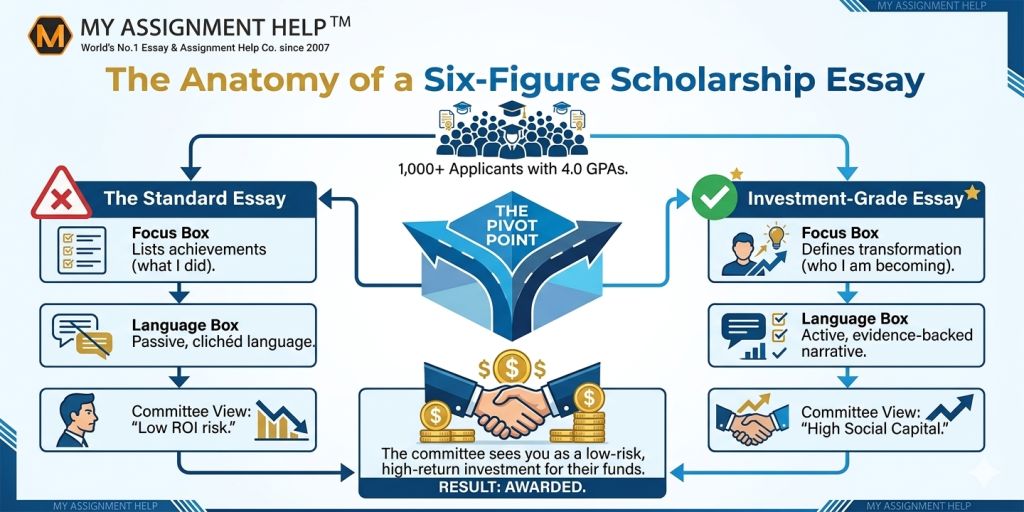
Scholarship committees at this level aren’t just looking for “good students”; they are looking for “investment-grade” individuals. They want to know that their capital will yield a high social or professional return. A mediocre essay focuses on what you have done; a six-figure essay focuses on who you are becoming and why the committee’s investment is the necessary catalyst for that transformation.
Crafting the “Investment-Grade” Story
To move a committee to award $100,000 or more, your writing must transcend the standard academic summary. It requires a blend of vulnerability, clarity, and strategic alignment with the donor’s values.
Many students struggle to strike the balance between humility and self-advocacy. This is where professional guidance becomes invaluable. If you find yourself staring at a blank page, you can seek expert assistance to write my assignment or provide a structural critique of your drafts to ensure your narrative remains cohesive.
The Anatomy of a High-Value Personal Statement
- The Hook (The Inciting Incident): Start in the middle of the action. Avoid “Since I was a child…” Instead, describe a specific moment of challenge or realization that defined your academic trajectory.
- The Pivot (The Learning Curve): Connect your personal experience to a broader societal issue. If you are studying environmental law, link a personal encounter with pollution to a systemic need for policy change.
- The Evidence (EEAT Principles): Selection committees value Experience and Expertise. Use specific data or project outcomes to back up your claims. If you led a fundraiser, don’t just say it was “successful”—say it “raised $15,000, a 20% increase over the previous year.”
- The Alignment (The “Why Us?”): Explicitly state why this specific scholarship is the only way you can achieve your goals.
Navigating these nuances requires a deep understanding of admission psychology. Many successful applicants utilize specialized resources like the Personal Statement Writing Service at myassignmenthelp to refine their process, ensuring that every sentence serves a dual purpose: revealing character while demonstrating academic rigor..
Data-Driven Success: Why Quality Matters
Research from the Journal of Student Financial Aid suggests that clear, concise, and “vivid” writing significantly increases the scores assigned by scholarship reviewers. In a blind study, essays that utilized “active voice” and “concrete imagery” were 40% more likely to be shortlisted for interviews than those using passive, abstract academic language.
Furthermore, with the rise of AI-generated content, scholarship boards are now using advanced detection tools. A “six-figure” essay must be authentically human. Any hint of robotic phrasing or generic “hallucinations” will lead to immediate disqualification. Authenticity is the ultimate currency in 2026.
Strategic Tips for Different Scholarship Tiers
- Institutional Merit Scholarships: Focus on how you will contribute to the specific campus culture.
- Private Foundation Awards: Align your personal “mission statement” with the foundation’s specific philanthropic goals (e.g., social justice, STEM innovation).
- Government-Funded Grants: Emphasize your potential for public service and national impact.
Key Takeaways
- Think Like an Investor: View your scholarship as a business proposal where you are the “startup.”
- Specificity Over Generality: Use data, names of projects, and specific outcomes to build authority.
- Human-Centric Content: Ensure your essay is free of AI-generated patterns; committees prioritize “voice.”
- Professional Polish: Small errors in a $100k application suggest a lack of attention to detail. Professional proofreading is a necessity, not a luxury.
FAQ Section
Q1: Can I reuse the same personal statement for multiple scholarships?
A: No. While the core story may remain the same, each statement must be tailored to the specific values and mission of the awarding body. A “one-size-fits-all” approach is the fastest way to lose a six-figure opportunity.
Q2: How long should a six-figure scholarship essay be?
A: Most prestigious scholarships have a word limit ranging from 500 to 1,000 words. The goal is “density”—packing as much insight and evidence into every paragraph as possible without fluff.
Q3: Does the personal statement matter as much as my GPA?
A: For high-value merit scholarships, the GPA gets you through the door, but the personal statement gets you the check. At the final stage of selection, all candidates have high GPAs; the essay is the only tie-breaker.
Q4: Should I mention my financial need in a merit-based personal statement?
A: Only if it is part of your narrative of overcoming adversity. If the scholarship is purely merit-based, focus on your achievements and future potential rather than the “need” for funds.
Author Bio:
Dr. Sarah Jenkins is a Senior Academic Consultant and Lead Content Strategist at MyAssignmentHelp. With over 15 years of experience in higher education admissions and professional editing, Dr. Jenkins has helped hundreds of students navigate the complexities of scholarship applications. Her expertise lies in helping candidates translate their life experiences into compelling, high-stakes narratives that resonate with elite selection committees. When she isn’t auditing content for E-E-A-T compliance, she conducts workshops on “The Future of EdTech in 2026.”
References
- National Center for Education Statistics (NCES). (2025). “Fast Facts: Tuition Costs of Colleges and Universities.”
- College Board. (2026). “Trends in College Pricing and Student Aid.”
- Journal of Student Financial Aid. (2024). “The Impact of Narrative Quality on Scholarship Outcomes.”
- U.S. Department of Education. (2026). “Navigating the Scholarship Landscape for Graduate Studies.
